

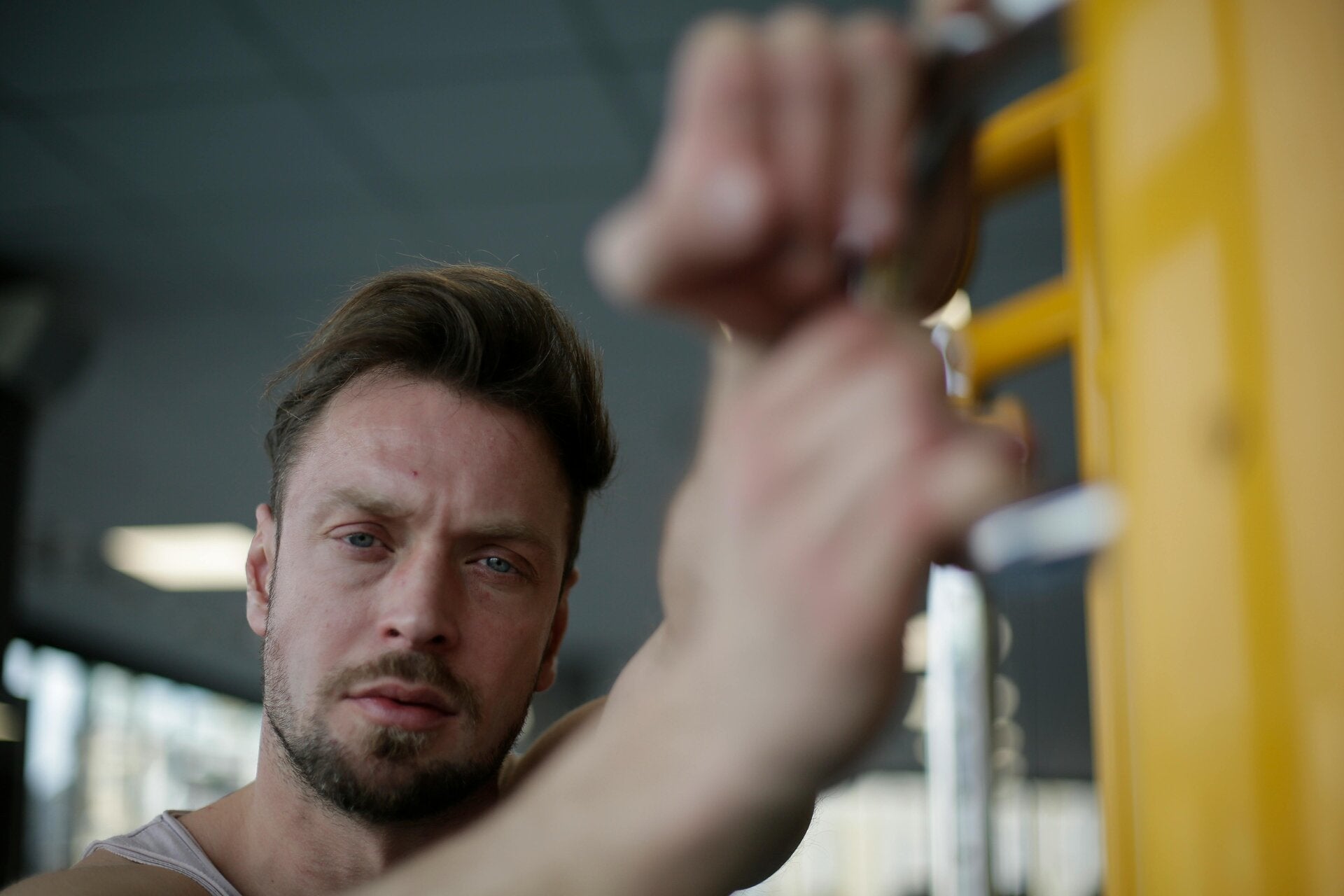
Are You Really a Hardgainer?
The term hardgainer has existed in bodybuilding for decades, describing naturally lean people who struggle to add muscle. While genetics certainly influence muscle-building potential, research suggests that very few people are incapable of gaining significant muscle mass. More often than not, slow progress comes down to insufficient calories, poor recovery, inconsistent progression or inappropriate training volume rather than bad genetics alone.
BUILD MUSCLE BY CREATING MECHANICAL TENSION
Muscles don't simply grow because you're tired—they grow because they're exposed to sufficient mechanical tension.
That means selecting a weight heavy enough that the final repetitions are genuinely challenging while maintaining good technique.
A useful rule is to finish most working sets with 1-2 repetitions left in reserve (RIR).
If you could have performed another six or seven reps, the load was probably too light.
Conversely, grinding every set to complete failure simply increases fatigue without necessarily increasing muscle growth.
COACH'S TIP
Aim to finish each working set thinking:
"I could probably have managed one more rep—but not two."
That is where most muscle growth occurs.
Progressive Overload Isn't Just Adding Weight
Many lifters believe progression means adding 5kg every week.
In reality, progression can come from several variables:
✔ One extra repetition
✔ Better technique
✔ Improved range of motion
✔ Slower lowering (eccentric) phase
✔ Shorter rest periods
✔ Additional training volume
✔ Increased load
The goal is simple:
Become slightly better than last week.
RECOVERY IS PART OF THE PROGRAMME
Muscle isn't built during training.
Training provides the stimulus.
Recovery creates the adaptation.
That means:
-
7-9 hours sleep (the most anabolic process there is)
-
At least two full rest days each week
-
Walking and mobility work on recovery days
-
Managing life stress
-
Eating enough calories to support repair
Remember: Recovery isn't the reward for training—it is part of the training.
Should Hardgainers Do Cardio?
Absolutely.
Cardio improves heart health, recovery between sets and overall work capacity.
The key is managing the dose.
Aim for:
-
1-2 low-intensity sessions weekly
-
20-40 minutes
-
Walking, cycling, rowing or swimming
Just remember to replace the calories you burn if your goal is to gain weight.
HARDGAINER SUCCESS CHECKLIST
Before blaming your genetics, ask yourself honestly:
☐ Am I eating in a calorie surplus every day?
☐ Am I consuming 1.6-2.2g protein/kg?
☐ Am I gaining around 0.25-0.5kg per week?
☐ Am I getting stronger every month?
☐ Am I sleeping at least 7 hours?
☐ Am I training 2-4 quality sessions rather than 6 mediocre ones?
☐ Am I recovering between workouts?
If you've answered "No" to several of these, you've likely found the real reason your progress has stalled.
The Bottom Line
Most hardgainers don't need a secret programme.
They need patience.
Build your training around heavy compound lifts. Train with intent, leaving one or two quality repetitions in reserve. Progress gradually. Eat enough to support growth. Sleep like it's part of your programme.
Repeat that process consistently for the next twelve months.
Because while genetics influence how quickly you build muscle, consistency ultimately determines how much muscle you build.
HARDGAINER TRAINING PROGRAMMES
The following programmes are designed around one principle: maximum return from minimum effective volume.
Every session prioritises compound lifts, progressive overload and adequate recovery—the three ingredients that consistently produce muscle growth in natural trainees.
Before You Start
Warm Up (5–10 minutes)
-
5 minutes brisk walking, rowing or cycling
-
Dynamic mobility for hips, shoulders and thoracic spine
-
2–3 progressively heavier warm-up sets before your first compound lift
Progressive Overload
When you can complete the top end of the rep range on every set with good technique, increase the load by 2.5–5%.
Aim to finish each working set with 1–2 repetitions in reserve (RIR) rather than training to absolute failure.
PROGRAMME 1
Three-Day Full Body Programme
Ideal for beginners and intermediate hardgainers
Monday – Workout A
-
Back Squat – 4 × 5–8
-
Bench Press – 4 × 6–8
-
Pull-ups or Lat Pulldown – 3 × 8–10
-
Romanian Deadlift – 3 × 8–10
-
Dumbbell Lateral Raise – 2 × 12–15
-
Standing Calf Raise – 3 × 12–15
-
Hanging Leg Raise – 3 × 12–15
Wednesday – Workout B
-
Deadlift – 3 × 5
-
Incline Dumbbell Press – 3 × 8–10
-
Chest-Supported Row – 4 × 8–10
-
Walking Lunges – 3 × 10 each leg
-
EZ Bar Curl – 3 × 10–12
-
Rope Triceps Pushdown – 3 × 10–12
-
Plank – 3 × 45–60 seconds
Friday – Workout C
-
Front Squat or Leg Press – 3 × 8–10
-
Standing Overhead Press – 4 × 6–8
-
Pull-ups – 3 × 6–10
-
Bulgarian Split Squat – 3 × 8 each leg
-
Seated Cable Row – 3 × 10–12
-
Face Pull – 3 × 15
-
Cable Crunch – 3 × 15
PROGRAMME 2
Two-Day Full Body Programme
Perfect for busy professionals or lifters who recover best with lower weekly volume
Day One
-
Back Squat – 4 × 5–8
-
Bench Press – 4 × 6–8
-
Barbell Row – 3 × 8–10
-
Romanian Deadlift – 3 × 8
-
Parallel Bar Dips – 2 × 8–12
-
Crunches – 3 × 15
Day Two
-
Trap Bar Deadlift – 4 × 5
-
Standing Overhead Press – 4 × 6–8
-
Chin-ups – 4 × 6–10
-
Walking Lunges – 3 × 10 each leg
-
Dumbbell Curl – 3 × 10–12
-
Farmer's Walk – 3 × 30 metres
Training Schedule
-
Monday: Day One
-
Thursday: Day Two
(Allow at least 2–3 days between sessions. If recovery is poor, train every fourth day instead of following a strict weekly schedule.)
PROGRAMME 3
Four-Day Upper/Lower Split
For lifters with solid recovery and at least a year of consistent training.
Monday – Upper Strength
-
Bench Press – 4 × 5
-
Weighted Pull-up – 4 × 6
-
Incline Dumbbell Press – 3 × 8
-
Seated Row – 3 × 8
-
Face Pull – 3 × 15
-
Triceps Extension – 3 × 12
Tuesday – Lower Strength
-
Back Squat – 4 × 5
-
Romanian Deadlift – 4 × 6
-
Walking Lunges – 3 × 10
-
Standing Calf Raise – 4 × 15
-
Hanging Leg Raise – 3 × 15
Thursday – Upper Hypertrophy
-
Incline Press – 3 × 10
-
Lat Pulldown – 3 × 10
-
Dumbbell Shoulder Press – 3 × 10
-
Chest Supported Row – 3 × 12
-
Dumbbell Curl – 3 × 12
-
Rope Pushdown – 3 × 12
-
Lateral Raise – 3 × 15
Friday – Lower Hypertrophy
-
Front Squat – 3 × 10
-
Leg Press – 3 × 12
-
Romanian Deadlift – 3 × 10
-
Leg Curl – 3 × 12
-
Calves – 4 × 15
-
Cable Crunch – 3 × 15
HOW HARD SHOULD YOU TRAIN?
Every exercise should finish with 1–2 repetitions in reserve (RIR).
If you could perform another five or six repetitions, the weight is too light.
If your technique completely breaks down, the weight is too heavy.
Stay in the sweet spot.
WHEN TO ADD WEIGHT
Once every working set reaches the top of the prescribed rep range:
Example:
Week One
Bench Press
80kg × 6
80kg × 6
80kg × 7
80kg × 6
Week Two
80kg × 8
80kg × 8
80kg × 8
80kg × 8
Increase to 82.5kg the following session.
EVERY SIXTH WEEK
Reduce volume by around 40–50%.
Use approximately 80–85% of your normal training weights.
This "deload" allows fatigue to dissipate while maintaining strength and prepares you for another productive training cycle.
HARDGAINER RULES
✓ Prioritise compound exercises.
✓ Leave the gym feeling challenged—not exhausted.
✓ Eat in a consistent calorie surplus.
✓ Sleep 7–9 hours every night.
✓ Walk daily and include one or two light cardio sessions each week.
✓ Keep a training log.
✓ Focus on getting stronger over months, not days.
Remember, muscles grow from consistent progressive overload combined with adequate recovery—not from chasing soreness or spending hours in the gym.
The Office Gym Club Challenge
If you are motivated, disciplined, and prepared to put in the hard work for real gains, this program is for you. There are no shortcuts and no excuses—just you, the barbell, and your determination to grow. If you’d like us to review your form, feel free to ask or send us a message.
Office Gym Club Cornwall is North Cornwall’s most talked‑about fitness community — a powerhouse of people training hard just outside Padstow, across the way from Wadebridge and St Columb. With a strong membership base and a reputation for serious results, we’re redefining what local fitness means. Whether it’s strength training, functional workouts, or corporate wellbeing partnerships, our gym stands for commitment, community, and progress. Join the movement that’s putting Cornwall on the fitness map.
Coach's Commentary: The Truth About Hardgainers and Building Muscle Naturally
If you've searched for the best hardgainer workout, how to gain muscle with a fast metabolism, or why can't I build muscle despite working out, you're asking the same questions thousands of naturally lean lifters ask every day.
The good news is that being a so-called hardgainer isn't a diagnosis—it's simply a description of someone who finds it more challenging to gain weight and muscle than average. While genetics certainly influence your potential, they rarely prevent you from building an impressive physique. More often than not, slow progress is the result of inconsistent nutrition, poor recovery, insufficient progressive overload, or simply following training programmes that aren't designed for natural lifters.
One of the biggest myths in bodybuilding is that hardgainers need to train more. In reality, many would benefit from doing less—but doing it better. A well-structured programme built around compound exercises, sensible training volume, progressive overload and adequate recovery will almost always outperform marathon gym sessions packed with unnecessary isolation work.
Nutrition is equally important. If you're not consistently eating in a calorie surplus and consuming enough high-quality protein, your body simply won't have the raw materials required to build new muscle tissue. Many self-confessed hardgainers are surprised to discover that they aren't eating nearly as much as they thought once they begin tracking their food intake.
Recovery deserves just as much attention as training. Muscle growth doesn't happen while you're lifting weights—it happens afterwards, when your body repairs and adapts to the stress you've placed upon it. Prioritising seven to nine hours of quality sleep, managing stress and allowing adequate rest between sessions can often produce better results than adding another workout.
If your goal is to gain muscle naturally, build size with a fast metabolism, or find a hardgainer workout programme that actually works, focus on the fundamentals. Train consistently using progressive overload, prioritise heavy compound lifts, eat enough nutrient-dense food to support growth, and give your body the time it needs to recover. Those habits, repeated week after week and month after month, are what transform physiques.
The reality is that there are very few true hardgainers—only lifters who haven't yet found the right combination of training, nutrition and recovery for their body. Stay patient, trust the process and commit to consistent progress rather than chasing shortcuts. Muscle isn't built overnight, but with the right plan and enough persistence, almost anyone can become bigger, stronger and more muscular than they ever thought possible.
Add comment
Comments